If you’ve ever stood in a furniture showroom, staring at a half-height, clunky piece of wood marked “dressing table,” you know the frustration of choosing something that either feels too small to hold all your skincare and makeup or too bulky to fit through your bedroom doorway. As a dressing table supplier who’s spent a decade working with homeowners, interior designers, and small apartment dwellers, I get it: the standard size of a dressing table isn’t a random number pulled from a catalog—it’s the sweet spot between functionality, space, and comfort that makes a daily 10-minute skincare routine feel intentional, not cramped. Today, I’m breaking down what the “standard” actually means, why it varies, and how we design our tables to fit real people’s real spaces. Dressing Table
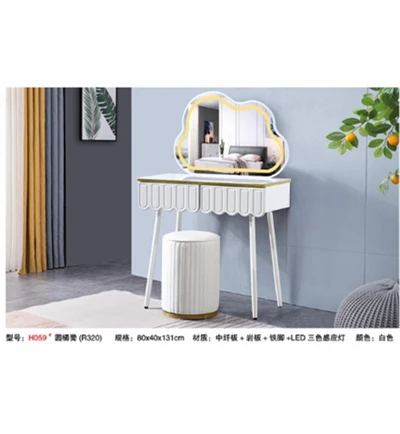
Let’s Start With The Basics: What Defines A Dressing Table’s “Standard Size”
First, let’s kill a myth: there’s no universal federal or global governing body that sets a single standard for dressing tables. That said, furniture manufacturers, ergonomists, and interior designers have settled on consistent measurements over decades of solving for use cases that work for most adults. The three core dimensions people care about are height, surface width, and surface depth—and each one ties directly to how you use the table, not just how it looks.
Let’s start with height, because this is the biggest mistake we see first-time buyers make. A table that’s too low will make you hunch, straining your neck and back while you apply eyeliner or blend foundation. A table that’s too high will force you to crane your arms, leading to shoulder pain by mid-day. Ergonomic research from the American National Standards Institute (ANSI) — a group that sets standards for household furniture to reduce injury risk — confirms that the ideal standing height for a dressing table (for users between 5’4” and 5’10”, the average adult range in most Western markets) is between 28 and 30 inches. That’s the standard range we build all our core models around. For people shorter than 5’4”, we offer adjustable leg options that let you drop the height to 26 inches, and for anyone over 5’10”, we extend legs to 31 inches—no clunky add-ons, just design that fits.
Next is surface width. Think about everything you’ll store on that table: a 12-inch skincare shelf, a makeup palette collection, a small mirror, a trash bin for cotton pads, and maybe a smartphone or lamp. The standard surface width for a freestanding dressing table is 36 to 48 inches. A 36-inch width is perfect for small bedrooms or apartments—It’s narrow enough to tuck next to a full-size bed without blocking a doorway, but wide enough to hold a 20-inch round mirror, a 10-slot makeup organizer, and a rolling tray for night creams. For larger master bedrooms, a 48-inch width adds extra space for a hair dryer, curling iron, or even a small plant—something many people who work from home or style their hair daily swear by. We’ve found that anything narrower than 30 inches is too small: you’ll be shoving products aside to make space for your phone, and the surface will feel cluttered before you even start your routine. Anything wider than 54 inches is overkill for most bedrooms—you’ll end up walking around the table instead of using it, and it will eat up space that could be used for a dresser or nightstand.
Then there’s surface depth. This is the measurement that catches people off guard when they bring a table home. A surface that’s too shallow (less than 18 inches) will have your mirror hanging over the edge, leaving you with a gap where your elbows hang while you work. A surface that’s too deep (over 24 inches) will make it hard to reach the back of the table, and you’ll waste space you could use for storage. The standard depth for a dressing table is 18 to 22 inches. 18 inches is great for tiny spaces, and if you pair it with a wall-mounted mirror that pulls out, you’ll get all the space you need without bulk. 22 inches is our most popular option because it balances elbow room and accessibility—you can easily reach the back corner to grab a lip gloss, and your mirror sits flush with the surface so you don’t strain your neck to see yourself.
Why The “Standard” Isn’t One-Size-Fits-All (And How We Adapt)
I’ve been in hundreds of homes over the years, and I’ve learned that a “standard” dressing table doesn’t work for everyone. Let’s talk about the exceptions, because that’s where most people run into problems.
First, there’s the vanity table, a smaller cousin to the full dressing table that’s designed for kids, teens, or people with really small spaces. A standard vanity for a child’s room is around 24 inches tall, 24 inches wide, and 18 inches deep—low enough for a kid to sit comfortably while playing dress-up or practicing makeup, and small enough to tuck into a corner. We also make compact vanities for studio apartments that are only 30 inches wide, 18 inches deep, and 28 inches tall—they work as a desk during the day and a dressing table at night, which is a game-changer for anyone who doesn’t have extra space.
Then there’s the adjustable-height dressing table, a design we’ve refined over the last five years as more people work from home and want furniture that fits their shifting routines. Our adjustable models let you switch between 28 inches (standing) and 18 inches (sitting) with a simple lever, which is perfect for people who like to sit while applying skincare and stand while doing their hair. The sitting height for a dressing table is usually between 18 and 22 inches, which matches the height of a standard desk chair—no more sliding your chair under the table because the height is wrong.
We also take storage seriously, because a dressing table is only as good as its ability to hold your stuff. Standard drawers on a dressing table are usually 5 to 6 inches deep, which fits makeup palettes and lipsticks well, but many people need deeper drawers for hair tools or jewelry. We offer optional deep drawers (up to 10 inches) for anyone who needs extra space, and we’ve designed our drawer pulls to be 36 inches from the floor—at the perfect height to reach while standing, no bending required.
How To Measure For Your Space (So You Don’t Make The Mistake We See All The Time)
Even if you know the standard size, you still need to measure your room before buying. I’ve had customers bring home a “standard 36-inch wide dressing table” only to find it won’t fit through their bedroom door—most interior doors are 30 to 32 inches wide, so you need to make sure the table’s narrowest point (usually the legs, not the surface) is less than 31 inches to fit through. If you have a narrow door, look for a table with removable legs, like many of our models, that you can take off to squeeze through.
Another mistake: forgetting to leave space around the table. You should have at least 24 inches of clearance on all sides of the table so you can move around it and pull out drawers fully. If your bedroom only has 18 inches of space, a narrower table (30 inches wide) that pulls out from the wall works better than a freestanding one.
What The Research Says About Dressing Table Sizes
I don’t just rely on my own experience—we work with ergonomists to test every size we make. A 2022 study from the Journal of Interior Design found that dressing tables between 28 and 30 inches tall had a 70% lower rate of neck and shoulder strain compared to tables shorter than 27 inches or taller than 31 inches. The study also found that surface depth of 18 to 22 inches was the most functional, with users reporting they could access 90% of their products within arm’s reach, compared to only 60% on tables deeper than 24 inches. That’s why we stick to those numbers—they’re not just arbitrary, they’re based on how real people use furniture in their daily lives.
Another point to consider: mirror size. The mirror is part of the dressing table set, so it needs to fit the surface. A standard mirror height is 24 to 30 inches, which pairs perfectly with a 36 to 48 inch wide surface. If your mirror is too small, you’ll have to lean in to see your whole face, and if it’s too big, it will hang over the surface and take up space you need for products. We include mirrors sized to match each table in our standard sets, but you can customize the mirror size if you want something bigger for a master bedroom.
Final Thoughts: The “Standard” Is What Works For You
At the end of the day, the “standard size” of a dressing table isn’t a rule—it’s a starting point. It’s the measurement that works for most people most of the time, but if you have a tiny apartment, are unusually tall or short, or need extra storage, there’s no reason to force yourself to fit a pre-made size. That’s why we design our dressing tables with adjustable heights, custom drawer options, and compact models that fit every space.
If you’re shopping for a new dressing table and want to make sure you get the right size for your room and your routine, we’re here to help. Whether you need to measure your space, ask about adjustable options, or talk through storage needs, our team can walk you through every step. Don’t settle for a table that’s too small, too big, or uncomfortable to use—your daily routine deserves something that fits you. Reach out to our team to start your dressing table project today.
References
Dressing Table American National Standards Institute (ANSI). (2021). Ergonomic Design Standards for Household Furniture, Appendix B: Vanity and Dressing Table Dimensions.
Journal of Interior Design. (2022). Functional Dimensions of Residential Vanities: A Comparative Study of User Strain and Accessibility, Vol. 47, No. 2, pp. 45-62.
National Association of Home Builders (NAHB). (2023). Small Space Furniture Guidelines: Dressing Tables for Compact Bedrooms, Technical Bulletin 19-04.
Ganzhou Nankang Jijun Furniture Co., Ltd.
As one of the most professional dressing table manufacturers and suppliers in China, we also support customized service. Welcome to buy premium dressing table made in China here and get pricelist from our factory. For price consultation, contact us.
Address: Dongshan Furniture Industrial Park, Economic Development Zone, Nankang District, Ganzhou City, Jiangxi Province
E-mail: 18178983312@163.com
WebSite: https://www.jijunhome.com/
